Saturday, 14 March 2015
day off, st margaret of antioch's, binsey, yew pollen
Took a very welcome day off yesterday.
We visited the church of St Margaret of Antioch, Binsey, which I first wrote about early in the life of justthoughtsnstuff on 7th April 2010. (What a lot has happened since then!)
We were married at Binsey two decades ago - gosh!!
The church and its graveyard remain magical places. Yesterday, the yew flowers were covered in pollen and when we tapped them clouds of fine yellow dust sprinkled the air.
Saturday, 7 March 2015
wolvercote reindeer, anuario americanista europeo, natalia revuelta, cw-dh, master's res, 12 degrees c
Delighted to say that the canal towpath from Wolvercote is now dry enough to walk along without picking up acres of mud. Though an unexpected pair of reindeer greeted me as I crossed the bridge from Wolvercote Green at the beginning of the week.
Also loving cycling again!
The Anuario Americanista Europeo, mentioned last week, is now out. The whole issue dedicated to scholarly articles on the Digital Humanities and Latin American Studies.
On a related theme, there's a fascinating obituary in the Times today of Natalia Revuelta, the wealthy socialite who espoused Fidel Castro's revolution, became his mistress and was the mother of his daughter, Alina. For those who don't have access beyond the paywall, see the Washington Post obit.
Continuing to work on the creative writing Digital Humanities project and beginning preparations for the master's residence in a fortnight's time.
Temperature today forecast to hit 12 degrees C. Yey!
Sunday, 1 March 2015
snowdrops, anuario americanista europeo, digital humanities, matthew l jockers, lynn cherny, catherine chanter, the well, woodstock bookshop
Snowdrops and other spring bulbs out in the garden. Very cheering. Especially as I have a bad cold...
The cold hasn't stopped my cycling, though. Whether this was a good idea, time will tell.
Spent quite a lot of yesterday doing some translation and editing work on the English-language abstracts for the next issue of the Latin American Studies journal Anuario Americanista Europeo. The issue is dedicated to the Digital Humanities as they relate to Latin American research. I won't give away the subjects covered but it promises to be a terrific read.
Speaking of the Digital Humanities, I was fascinated by the latest blog post from Professor Matthew L Jockers on his investigations into shape in fiction (see also the one published earlier in the month). I came across his work after Lynn Cherny's talk in Oxford last September. His findings, published on 2nd and 25th February, have attracted a lot of attention, including an article and an editorial piece in the Times on Thursday (these articles are, of course, behind the Times paywall...). It'll be great to read more when he publishes his academic paper. For now I'm left wondering about the immediate usefulness of some aspects of the six 'plots' his programme has identified as the archetypal structures underlying the 40,000 or so novels in his corpus. On the one hand the idea that writers naturally conform to one of these meta-structures when they put pen to paper is thought-provoking. How does the writer come to follow one of these shapes? What are the processes that ensure such a standardised fictional output? But on the other hand, common sense tells you that these six plots can't be fiction's whole story. The novels we read in a lifetime are - aren't they - all so varied? I wonder what Digital Humanities can tell us about the complexity of fiction writing, as opposed to the broadest of patterns that they might (or might not?) conform to.
I was also intrigued to see that Professor Jockers found an innovative way of comparing the texts - all of which were of different lengths - by using science developed at CERN (see 2nd February post). This seems to have converted the texts into a form of data where length was no longer an issue, so that they could be compared, before converting them back again. It may be that this process was of itself inert and had no effect on the validity of the results. Yet, were the lengths of the novels properly factored into the six plots? Looking at these plots the impression is that all the books that follow a particular plot paradigm have exactly the same shallowness or depth of plot arc as it rises and dips. But in relation to the length of a work, surely the effect of each shape is going to vary significantly, depending on how long or short the work is. Aren't the dips going to be more strung out in a longer work and more intense in a shorter one? And if so, aren't the effects of the rises and falls in the plot arcs on the reader going to be different in each case?
The broad approach taken by Professor Jockers leaves many questions unanswered but, as he himself says, his research has produced a plethora of data, so the six plot shapes are just the start of the story!
Finally, I'm really pleased to learn that a former student of mine,Catherine Chanter, is having her first novel published by Canongate on 5th March. It's called The Well and I read an early draft of part of it a couple of years ago. It's a tremendous story (which plot arc did she choose?). If you live near Woodstock, you can see Catherine reading at the Woodstock Bookshop on the 10th March at 7 pm.
Sunday, 22 February 2015
oxford clay, first cycle ride of the year, hedging, allotment, spuds and squash
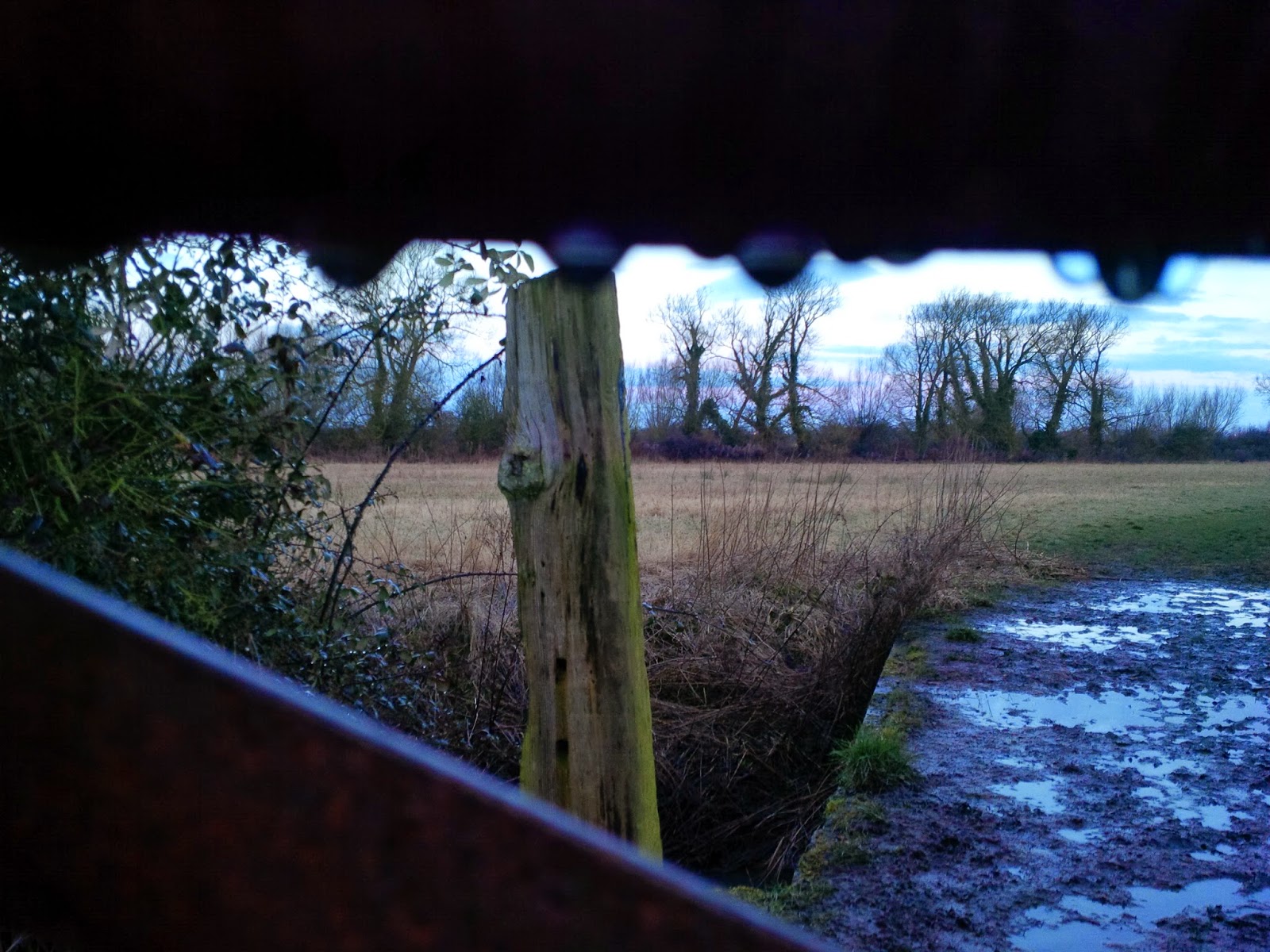
The above pics were taken during my walk yesterday morning. The water meadow beyond Glebelands was flooded in places and sticky with Oxford clay nearly everywhere. The higher fields weren't much better. Some strikingly vivid skies, though.
Today I went on my first cycle ride of the year. I didn't go out on the bike before now because of the frosts that seemed to coincide with the weekends when I could have gone and because of the lovely long walks to Clanfield J and I did every Sunday for the past three weekends.
Today's cycle was pretty short - just towards Brize (via the allotment), to Lew and back to Bampton over Mount Owen. The last of these was a touch challenging but I have to say that when I got back I knew what I had been missing. Wonderfully energising and refreshing exercise!
It was also great to see the landscape again from the perspective of a cyclist. Was intrigued to see some more hedging being done along the western edge of a paddock at the bottom of Mount Owen road. The person does a little bit every year - see post of January 2012 - and has now almost finished the whole hedge.
On the allotment, all is pretty much finished now. I pulled some beetroot last weekend but only one was any good - the others had been too badly frosted. Carrots have been eaten by rabbits and the slugs are getting everything else. Still, it was fun going to the shed at the house earlier for pink fir apples, kestrel spuds and a squash from the hessian sacks hanging from the rafters.
Saturday, 14 February 2015
mist wisping and puffing, memories of the mull of galloway, hazel catkins, digital humanities project
A chilly start to the day with mist wisping and puffing from the ground when I set off on my walk at around seven. The mist seemed only to rise a little before dispersing and was soon all gone. A beautiful clear light followed that occasionally triggered a memory of September lights on the Mull of Galloway in the mid-eighties.
A joy, seeing hazel catkins in abundance in the Millennium Wood.
A week of library work and finding out more for my Digital Humanities project.
Friday, 6 February 2015
inspiring meeting at oerc, mst promo video
Lots going on this week.
Libraries busy. A fascinating and inspiring meeting at the Oxford e-Research Centre about the Digital Humanities fiction project I'm interested in doing. Assignment tutorials during the week and tomorrow.
This week I also learned that the promotional video for the Master of Studies in Creative Writing has been launched. Loved seeing colleagues and former students on film. For myself - well, this was done before the sideburns came off. Quite weird seeing them again!
The above pic shows Stephanie Scott who won the AM Heath Prize and whose short story, Pulau Brani, recently won the Writers’ Village International Short Fiction Award.
Saturday, 31 January 2015
snow, digital humanities, creative writing as therapy, melvyn bragg, remember me, trust: a family story
A snowy walk this morning. Snow completely unexpected - indeed the online weather page still hadn't picked up on it even after it had fallen.
The snow isn't sticking around, though, and as I write it has almost all gone from the street outside my office window.
It's been a week of library and MSt work and of some Digital Humanities discussions and of others on creative writing as therapy. The DH discussions related both to the library and to a creative writing project I'm exploring - more on this in future posts if, as they say, it has legs.
The creative writing as therapy discussions were very thought-provoking. The person I was talking to via email and over coffee was studying for an MSc in Creative Writing for Therapeutic Purposes. I was very intrigued to learn of this course, having used creative writing therapy as a structuring device in Invisible. In the novel both narrators are writing out their experiences in order to come to terms with them - one on the advice of a doctor, the other in diary form.
During our exchanges, we touched on, amongst other things, a talk I had given about writing therapy when I was editing Invisble, Melvyn Bragg's autobiographical novel Remember Me, and my own experiences of life-writing as therapy.
Bragg's novel was the fourth in a series that began with The Soldier's Return and concerned the period when he separated from his first wife and her suicide sometime later. For Bragg, the book wasn't a therapeutic exercise, as he explained in an interview in 2008 with Richard Brooks in the Sunday Times (pub 30th March 2008):
'...Bragg, who also presents Radio 4's In Our Time, said that he had not written the book as a cathartic exercise. "The idea of something like this being therapy is absolute rubbish," he said. "It just makes things worse.
'It's stirred up stuff so that I've thought again and again: why didn't you just leave it alone? You were managing."
'Yet Bragg, who wrote at least seven draft versions before he felt satisfied, does not regret the book's publication: "I don't wish I hadn't written it. But it has sort of muddied up something I was keeping suppressed. I think it has made my life, and the lives of other people, a lot more difficult."...'
I reviewed Bragg's novel for the Times and had also reviewed two of the previous books in the series - one for the FT, the other for the Times. While I'd enjoyed the two earlier novels, I found Remember Me quite a difficult - and dark read. It doesn't have the objectivity on Bragg's early life that the others had. In the previous ones he was able to turn real life into good, highly readable fiction, whereas in Remember Me one got the impression that the struggle to cope with the emotionally-charged and painful material was still raw and jagged (not surprisingly). It is nevertheless an intriguing work and a brave, honest one to have written. (See my review below.)
During our exchanges about writing therapy last week, I was asked whether I had found writing the narratives that make up Trust: A family story to be therapeutic. I said I felt that the one I wrote in 2012, not long after my father's death, hadn't been therapeutic but that the one written last September had been:
'The editing [of the 2012 narrative] was painful because everything...was still so raw - and, yes, reading everything back and rewriting what I had written so that it worked as prose properly was pretty destabilising. Whereas, writing the last narrative was very easy to do - looking at it now, it requires very little editing and seems lucid and focused compared with the piece of three years ago. It was also very cathartic to write.'
Creative writing as therapy is a fascinating and complex area - one, I imagine, we're only just beginning to understand. One other question I was asked was whether my students found their creative writing work therapeutic. I don't know the answer to this because it isn't - generally - something we discuss. But the question of writing therapy in relation to creative writing courses would make an interesting study.
Now, the review (pub 22nd March 2008):
REMEMBER ME by Melvyn Bragg
This is the fourth in a series of novels in which Melvyn Bragg dissects a fictional life that bears an uncanny resemblance to his own and explores its cultural and psychological contexts.
The previous book, Crossing the Lines, ended in 1959 when Joe Richardson left Cumbria to study at Oxford and subsequently split up with his first love. Now it is a year later and Joe meets Natasha, a French art student in her mid twenties, who is haunted by her traumatic childhood. He recognises in her "a fellow loneliness" and they become lovers. Unknown to them, they have begun "an embrace to the death". Joe is looking back at events more than 40 years later and early in the narrative reveals that Natasha will commit suicide.
However, the relationship between their younger selves starts auspiciously enough. After Joe's final exams he and Natasha marry and visit her family in Provence, where her painful memories are anaesthetised by his love. In London he takes up his traineeship with the BBC and she adapts to her role as housewife by being "happy in his happiness", despite her daytime solitude. They both have literary ambitions (which will be fulfilled) and when he gets home they sit at their kitchen table and write. After a spell in Newcastle they move back to London, where they buy a house in Kew Gardens and Joe's career as a television producer takes off.
It is only after Natasha gives birth to their daughter that things begin to change. Just when Joe seems to have everything he has ever wanted, his self esteem plummets and he is frustrated by the sense that he is missing out on new opportunities in a city he finds "tempting, enthralling, poisoning, transforming". Both he and Natasha experience periods of mental instability and struggle with suicidal impulses before undergoing psychoanalysis.
Bragg has himself suffered from depression and as president of the mental health charity Mind has spoken movingly about the suicide of his first wife in 1971. But the interplay of fact and fiction in this novel can sometimes make it seem overly confessional and raises some unsettling questions. To what extent does Bragg identify with the older Joe's condemnation of the "flawed and disturbed man" he used to be or with such feelings as Joe's "deep strike of guilt"?
Whatever the answers, Bragg successfully uses his knowledge of mental illness to explore the subject through his imagination. His descriptions of Natasha's crippling isolation when she fights the "relentless surging tides of darkness" are particularly convincing. Nevertheless, there are some things that are more sketchy, including what Natasha went through as a child. Perhaps this apparent lapse is intended to make a point: such suffering is personal and invisible.
This is a powerful novel that communicates difficult emotional truths. Yet its dark themes are balanced by the vivid portrait it paints of 1960s London and by its evocation of the profound love that outlasts Joe and Natasha's gradual estrangement.
Friday, 23 January 2015
john
A blisteringly cold morning. Minus eight over by Benson and minus five or six in Bampton and Oxford. One good thing to come of this was that the canal towpath was frozen and I could walk it happily for the first time since October, I think. Once the towpath gets too muddy, I have to stop walking the northern part from Wolvercote to Aristotle Lane, because otherwise my shoes pick up too much of the stuff and I inadvertently scatter trails of it throughout the library. The cold makes the usual walk much more tiring though.
This week, I was very, very sad to hear of the death of John Bayley, to whom I owe so much.
I first met John in 1984 – and almost blew my chances of getting into Oxford to study English.
Before then I'd contacted about half-a-dozen admissions tutors at various colleges, who all said the same thing. I was by then in my mid-twenties and a land agent. The tutors explained that because of the cuts being imposed by Mrs Thatcher's government they were not minded to give undergraduate places to mature students, only school leavers. I began to lose hope.
At the pub in Steeple Aston, the north Oxfordshire village where I was living, a friend suggested I get in touch with an Oxford don called John Bayley who lived locally. I wrote a letter and heard nothing for six weeks. Then a card arrived, suggesting I came to his house in the village and we could talk about what I was trying to do. He apologised for not having written before but he had been in America on, I believe, a book tour with his wife, the novelist Iris Murdoch.
When I arrived at the house it looked deserted, a sort rural Sunset Boulevard house, overgrown and in places badly in need of repair. When I knocked nothing happened. Not a sound. Just when I thought there was no one in, the door was pulled open and Iris stared at me almost angrily. She was dishevelled and suspicious, asking me over and over what I wanted, ignoring my explanation (which I must confess was bound to have been long-winded, as is my way), until she evidently concluded that I was one of John's students and said she would fetch him. I was somewhat shocked by her appearance and manner – a stone-age woman at the mouth of her cave.
When John appeared, all I could see were legs and a huge jumper which covered his head and looked like a bag in which something was fighting. An arm shot through one of the many holes in the jumper only to be withdrawn. There was muttering before all of a sudden his arms found the sleeves and his head popped up. Straightening his glasses he said stutteringly, 'A bit déshabillé.'
Though in my mid-twenties, I was not past the age of getting the giggles and it was all I could do to stop collapsing in front of him. Even more so when we started talking. His way of talking was circuitous and curiously diffuse. He used a lot of 'so to speaks' and 'frightfullys' and at first it was as though he was talking nonsense. The words were like bubbles being blown over my head and off across the drive. But he had a direct way of looking at you and his scrutiny was intent and kindly. It became clear that he had a very incisive idea of how we would proceed and he brought things to a close with an encouraging outline of his plan. He wanted me to meet a colleague of his at St Catherine's College, Michael Gearin-Tosh (who sadly died many years ago now), and I would explain to him what I knew about English literature.
I wrote two essays for Michael, who said that he would discuss what I had put with John. John then told me that while Michael didn't think that I was right for St Catz, there were in Oxford, in fact, colleges that might consider applications from mature students. (As an aside, although I always got on well with Michael, he told me a year or so later that he had recently been approached by another mature student. He went on to list the many things the person didn't know and the problems he was having trying to study English literature. Michael finished by saying, 'But I think he's better than you were.')
John explained that if I was to have any hope of getting a place, I would have to agree to sit Oxbridge in open competition with school leavers rather than go through the mature student application process, which was supposed to put less pressure on the prospective student and take into account skills learnt in other walks of life. The only hope of doing well in the Oxbridge exams was to study full time with a tutor. I gave up my job and enrolled with someone who had been with Green's Tutorial College but had recently gone freelance.
I approached the five colleges John suggested and three said they would consider an application. At the end of the year I got a place at Keble. My practical criticism paper attracted the attention of the marker, Frank Cottrell Boyce.
I realised then and more so now how much time John gave me. He didn't pull strings but established what I knew and what I was like as a person and then gave me really sound advice about not just the colleges who might consider my application but where I might fit in if I was lucky enough to get a place. John's generosity – and Michael's – was a wonderful gift to me and I cannot thank them enough. That they took an interest and took my aspirations seriously was a tremendous boost to my confidence.
When at Oxford, I attended some rather ad hoc lectures on Shakespeare given by John and chatted from time-to-time. After I left I told him I was going to try and write fiction. Over the coming years he read six or seven novels of mine that won't see the light of day but which he gave feedback on. He introduced me to Iris and for a couple of years, J and I got to know them as friends. We visited their house in Oxford (they had moved from Steeple Aston by then) and they came to supper in our tiny flat. I have memories of going to the launch of Angela Huth's Invitation to the Married Life with them, of seeing a play at the Old Fire Station with them and Peter Shaffer. There was the launch of John's novel Alice. He and Iris came to the Waterman's Arms on Osney for our wedding party after we were married at Binsey. It was at the Waterman's that we realised something was wrong.
I remember how close John seemed to a breakdown himself during Iris' illness, though I only saw him a little during that time. I remember speaking to him after a talk he gave about Alzheimer's and his books at Blackwell bookshop. Not that it was easy to get to him because there were so many people in middle-age and old-age who wanted to talk to him about their own experiences. It was very clear how they valued reading what he had put into words about what it was like to look after someone they loved who had the disease.
I remember going to supper with John and his second wife Audi at the Cherwell Boathouse. There were a lot of us there that evening, including Peter J Conradi, Iris' biographer. John and Peter were due to speak at the Oxford Union that night.
John looked remarkably well. Gone were the threadbare charity shop clothes. Now Audi had him in things that were still unusual – and completely John – but which must have come from a much more discerning charity shop. That evening I gave him a copy of my first published novel The Lock, which had a quote from him on the cover: '"Original, illuminating and absorbing." John Bayley, author of Iris: A Memoir of Iris Murdoch'.
Thank you, John. Thank you so very much.
Saturday, 17 January 2015
freezing start, memories, early walk, assignment marking, snow, noughth week, things hotting up, jtns 50,000th
Freezing start to the day, with the roads and pavements glassy, so definitely NO cycling. Memories of coming off the bike a few years back still vivid.
Set off on a walk before seven because I'm marking assignments this weekend and have a fair bit to get through.
Photos show the churchyard with a clear skyline then, just a few minutes later, conditions worsening in Bridge Street. Not that the snow came to much in the end.
Oxford full term begins on Monday, though things during Noughth Week were already hotting up.
Oh, and according to Blogger stats, justthoughtsnstuff had its 50,000th pageview this week. And no, they're not all me...
Subscribe to:
Posts (Atom)